Back to blog
What Is a Tokenized Money Market Fund? How It Differs From a Tokenized Treasury
Most tokens marketed as tokenized Treasuries are shares in a money market fund recorded on a blockchain. This explains what the fund wrapper is, how it delivers yield, why it made these tokens usable as collateral, and where the risks sit.
BounceBit
Official Blog

A tokenized money market fund is a share in a regulated money market fund that is issued and recorded on a blockchain, where the token represents ownership of a diversified portfolio of short-term government instruments such as U.S. Treasury bills, overnight repurchase agreements, and cash. The token carries the fund's net asset value and its accrued yield, and it can be transferred between whitelisted wallets around the clock. In Franklin Templeton's description, tokenizing a money market fund replaces the transfer-agent function, the traditional record-keeper of fund ownership, with a blockchain-based system for issuing and tracking shares.
That definition matters because most of what the market calls "tokenized Treasuries" are, structurally, tokenized money market fund shares. BlackRock's BUIDL and Franklin Templeton's BENJI, the two products most often cited in the category, are fund shares wrapped as tokens, and the fund layer beneath them shapes how they generate yield, how they redeem, and how they behave as collateral. Understanding the fund wrapper is the difference between treating one of these tokens as a direct IOU on a single bill and treating it as what it is: a regulated fund share that happens to settle on a public ledger.
Key takeaways
A tokenized money market fund holds a managed pool of short-term government paper, so its yield and risk profile reflect a diversified fund rather than a single security. Yield accrues inside the fund and reaches the holder either through a rising share price or through additional tokens distributed to the wallet. The fund wrapper is precisely what has made these tokens acceptable as institutional collateral, because a fund share carries a daily NAV, an administrator, and a redemption path that counterparties can price. The structure also imports the fund's constraints: business-day redemption at the primary layer, whitelisting, and the plain reality that a money market fund can lose value.
A fund share, not a claim on a single bill
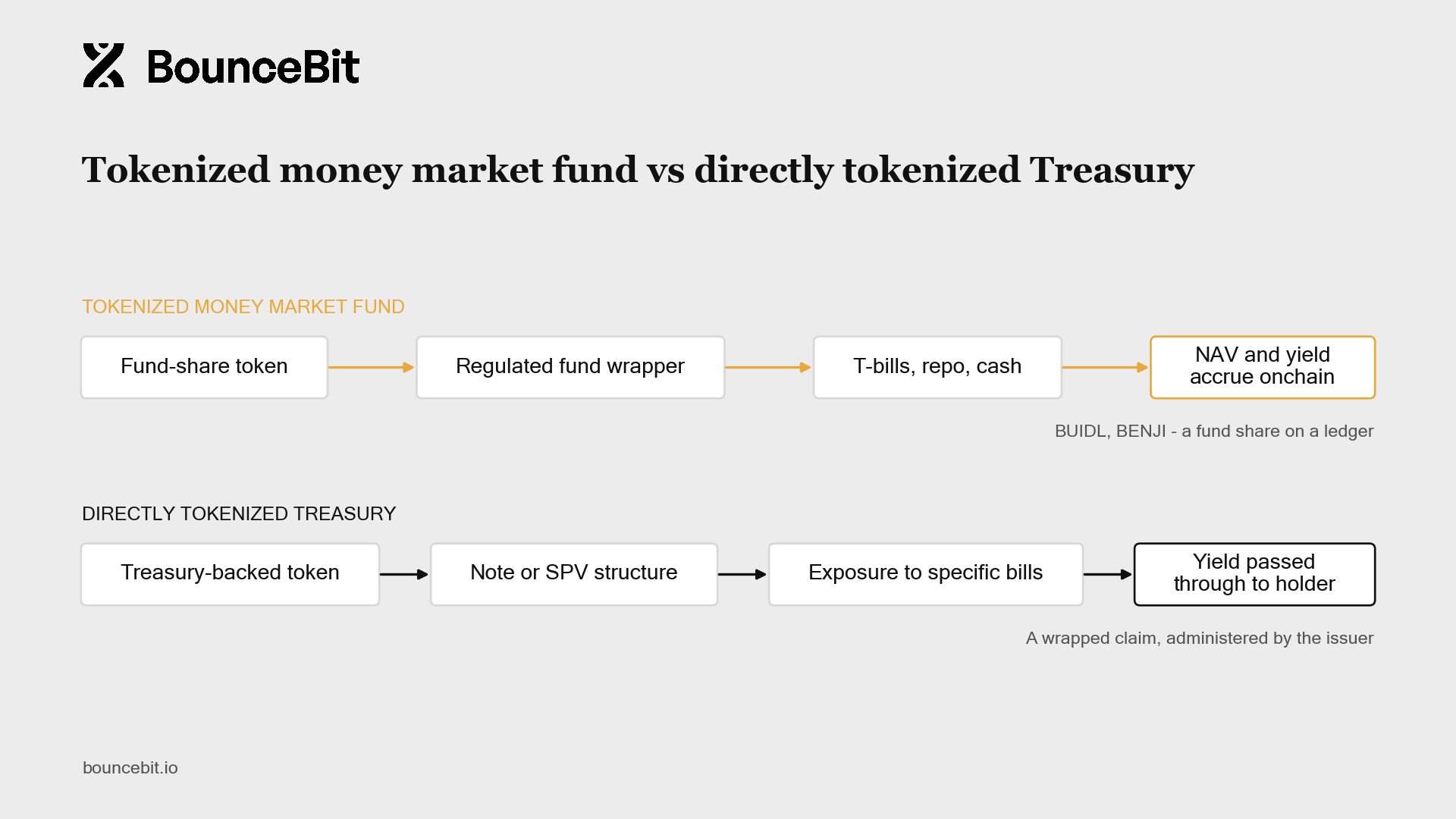
The core distinction is legal and structural. A money market fund is a pooled vehicle that a manager runs against a mandate, holding a laddered book of Treasury bills, repo, and cash, marking a net asset value each business day, and paying out the interest those holdings earn. Tokenizing it does not change any of that. It changes the register. Ownership that once lived in a transfer agent's database is recorded on-chain, and the share becomes programmable and transferable without an intermediary re-papering the trade.
A directly tokenized Treasury, by contrast, is a token engineered to track exposure to specific underlying bills, often through a note or special-purpose structure that is not itself a registered fund. The holder's yield still comes from Treasuries, but the wrapper, the diversification, and the party standing behind redemption differ. Both categories sit inside the broader move of tokenized Treasuries into onchain utility, and in casual usage the labels blur. For anyone using the instrument as collateral or as a cash-management tool, the wrapper is the part that determines counterparty exposure and redemption certainty, so it is worth keeping the two apart.
Money market funds became the first mainstream tokenization target for a reason. The asset is short-dated, low-volatility, and already administered by regulated managers with daily NAV processes, which makes it the cleanest existing product to move onto a ledger. That is why traditional managers moved first: Franklin Templeton launched BENJI in 2021, and by 2025 BlackRock, BNY Mellon, and Goldman Sachs had all brought tokenized money market funds to market.
How the fund wrapper delivers yield
Yield in a tokenized money market fund originates exactly where it does in the offline version: the fund earns interest on its holdings of Treasury bills, repo, and cash, nets out its expenses, and passes the remainder to shareholders. What tokenization changes is the delivery mechanism, and two designs dominate.
In the first, the fund holds the token's price constant, typically pegged at one dollar of NAV, and distributes accrued yield by issuing additional tokens into each holder's wallet on a schedule. A wallet's token count grows over time while the unit price stays flat, which is why integrators often treat these tokens like a rebasing balance. In the second, the token count stays fixed and the share price appreciates as interest accrues, so the holding grows in value rather than in units. Both deliver the same underlying Treasury yield; they differ in accounting, wallet behavior, and the tax treatment a holder sees. Neither design creates yield out of the token itself. The return is the fund's return, minus fees, and it moves with short-term interest rates.
This is also where the fund wrapper separates cleanly from the crypto-native yield sources that sit on top of it. A tokenized money market fund produces the base rate available on short-term government paper. Any return above that rate has to come from a distinct strategy, such as a market-neutral basis position, and it carries that strategy's own risk. Conflating the two is a common error in how these products are marketed.
Why the fund structure is what made them collateral
The most consequential property of the fund wrapper is that it made these tokens acceptable as collateral. A counterparty extending credit against an asset needs to value it, price its liquidity, and know who stands behind conversion to cash. A money market fund share supplies all three: a daily NAV struck by an administrator, a redemption path through the fund, and a regulated manager as the responsible party. Franklin Templeton lists collateral management among the explicit use cases for its tokenized funds, alongside treasury management, payments, and settlement.
The market has followed that logic. BlackRock's BUIDL, at roughly $2.9 billion when it was accepted as collateral on Crypto.com and Deribit in June 2025, has become a reference asset for posting Treasury exposure against derivatives positions. The appeal is capital efficiency: collateral that earns the Treasury base rate while it backs a trade, rather than sitting idle. That is the same principle behind off-exchange settlement arrangements, where an institution keeps assets with a custodian while a mirrored balance backs activity at a venue.
BounceBit's BB Prime platform is built directly on this property. It uses Franklin Templeton's BENJI as a collateral and settlement instrument inside structured strategies, so the base Treasury yield of the fund is retained while a market-neutral overlay is run on top. An earlier BounceBit pilot used BlackRock's BUIDL as collateral for a Bitcoin derivatives strategy that produced over 20% annualized returns during the test period, a figure specific to that pilot and its market conditions rather than a standing rate. In both cases the fund share is doing the work a Treasury bill cannot do alone: earning yield while remaining pledgeable, priceable, and transferable. This layering of a real-world-asset base with a crypto execution strategy is the defining pattern of CeDeFi.
Risks and limitations
The fund wrapper imports the fund's constraints along with its benefits. A money market fund can lose value; Franklin Templeton's own materials state plainly that these investments are not FDIC insured, carry no bank guarantee, and may lose value, with returns affected by changes in interest rates and credit conditions. The tokenization layer adds its own risks around custody, smart-contract execution, and an evolving regulatory treatment of blockchain-recorded shares.
Redemption is the constraint most often underestimated. A tokenized share can move between wallets at any hour, but converting it back to cash generally runs on the fund's business-day schedule, a gap that governs how quickly the asset becomes spendable and is worth understanding before treating it as cash. The mechanics of that gap are covered in detail in how redemption liquidity works in tokenized Treasury funds. Access is also gated: most of these funds transfer only among whitelisted addresses that have passed the issuer's onboarding, so the tokens are not freely composable across DeFi in the way a permissionless stablecoin is. And the yield, finally, is a floating short-term rate. When policy rates fall, the base return of every tokenized money market fund falls with them, and any headline return that exceeds the Treasury rate is coming from a separate strategy with separate risk.
FAQ
Is a tokenized money market fund the same as a tokenized Treasury?
Not exactly. Most tokens marketed as tokenized Treasuries, including BUIDL and BENJI, are shares in a money market fund that holds a diversified pool of Treasury bills, repo, and cash. A directly tokenized Treasury tracks specific underlying bills through a note or special-purpose structure that is not a registered fund. Both derive yield from Treasuries, but the wrapper and the party behind redemption differ.
How does a tokenized money market fund pay yield?
The fund earns interest on its holdings, nets out fees, and passes the remainder to holders. Some funds keep the token price fixed and distribute yield as additional tokens sent to the wallet; others keep the token count fixed and let the share price appreciate. Both deliver the fund's underlying Treasury yield.
What are BUIDL and BENJI?
BUIDL is BlackRock's tokenized money market fund, created with Securitize and backed by short-term U.S. government securities. BENJI is Franklin Templeton's tokenized U.S. government money market fund, first launched in 2021. Both are regulated fund shares issued and recorded on public blockchains.
Why are tokenized money market funds used as collateral?
Because a fund share carries a daily net asset value, a redemption path through the fund, and a regulated manager standing behind it, a counterparty can value and price it. That lets institutions post Treasury exposure as collateral while it continues to earn the Treasury base rate, which is more capital-efficient than posting idle cash. BUIDL was accepted as collateral on Crypto.com and Deribit in June 2025.
Can a tokenized money market fund lose value?
Yes. It is a money market fund, not a bank deposit, and its issuer states that it is not FDIC insured, carries no bank guarantee, and may lose value. Its yield is a floating short-term rate that falls when policy rates fall, and the tokenization layer adds custody, smart-contract, and regulatory risks.
Sources
Stay ahead of onchain capital flows.
Get insights on research, product updates, and execution insights from BounceBit.
No spam. Unsubscribe anytime. Your email is safe with us.